

Survival Before Success

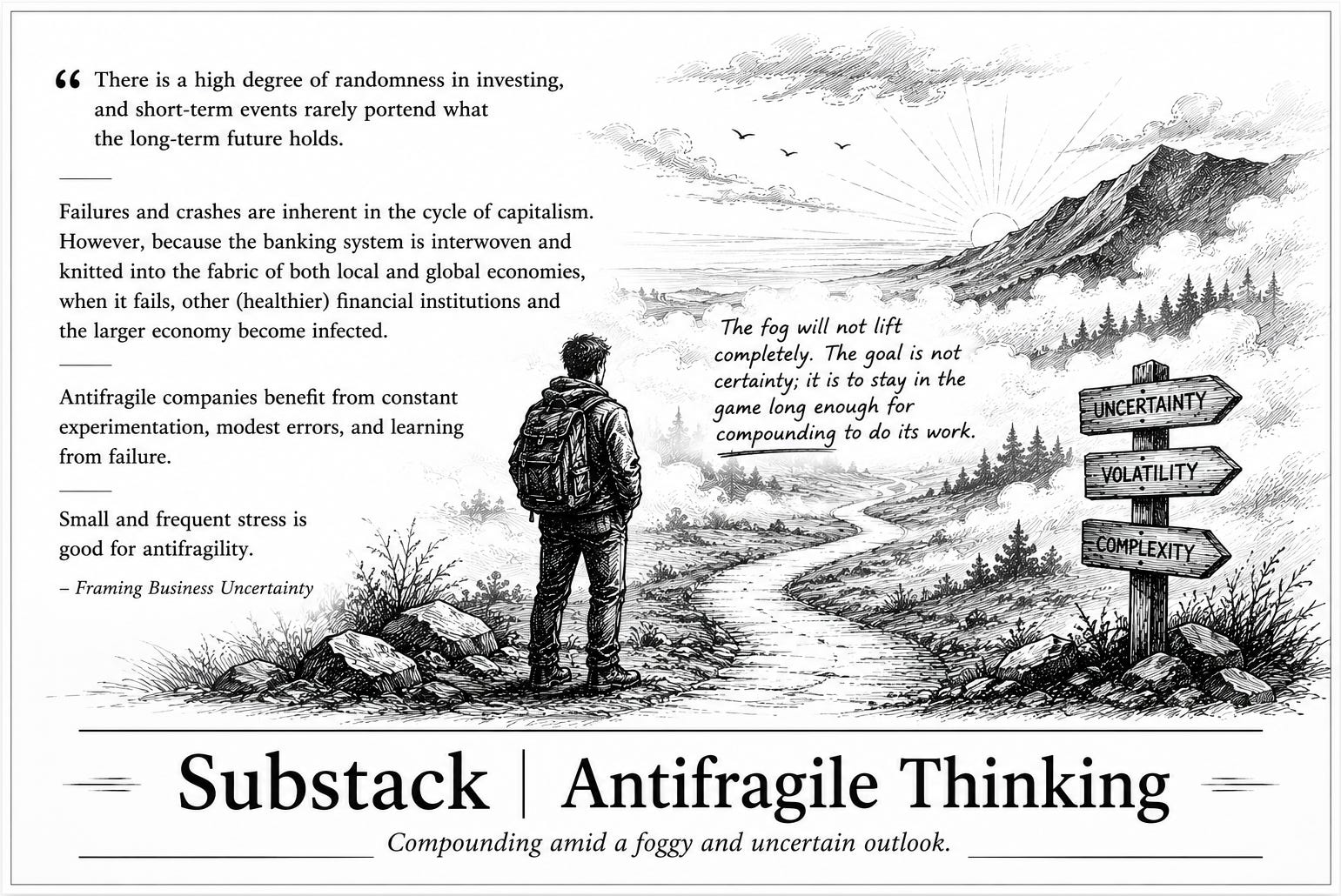
Most investing books explain success after the fact. Survivorship bias is almost unavoidable because the winners are already known. Framing Business Uncertainty takes a different approach. It was not written to backtest success. It was written to frame uncertainty before the outcome was known.
The real test begins now. The framework must prove itself across industries, business models, market cycles, periods of extreme uncertainty and, occasionally, through rare positive tail events. Some conclusions will hold. Others will need refinement. That is exactly how a useful framework should evolve.
The only validation that matters is whether the framework improves decision-making while the future is still uncertain, not whether it can explain the past once uncertainty has disappeared.
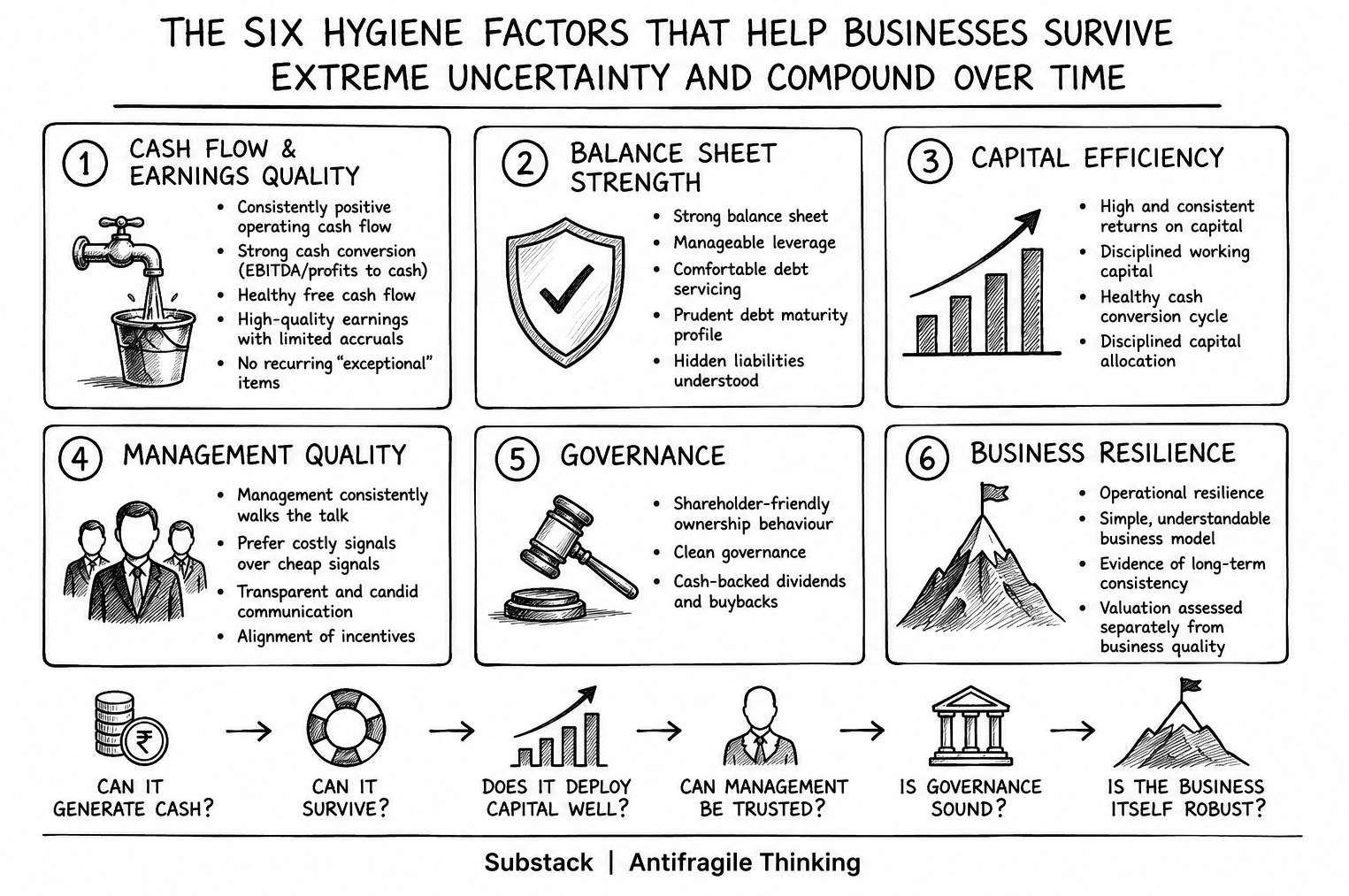
The accompanying presentation (link below) is a live demonstration of the key hygiene factors that help businesses survive periods of extreme uncertainty and create the conditions for long-term compounding. The examples are deliberately drawn from outside the pharmaceutical, chemicals and healthcare sectors to demonstrate that the framework outlined in Framing Business Uncertainty is industry-agnostic.
No framework can eliminate uncertainty. There will always be accidents and unexpected outcomes that are only obvious in hindsight. That is precisely why diversification matters. The objective is not to identify a single winner, but to build a portfolio of businesses with characteristics that increase the probability of long-term success while limiting the risk of permanent capital loss.
Over the past few decades, companies such as Divi’s Labs, Neuland Labs, Ajanta Pharma and Torrent Pharma have created extraordinary wealth, all starting from relatively small market-cap bases. Smaller companies today may deliver even greater percentage returns, but the search for multibaggers often leads investors either to overlook the fundamentals of asset quality, a judgement error, or to lose the patience needed to hold through prolonged periods of volatility and uncertainty. That is where most accidents happen. Prematurely exiting a long-runway business simply because the stock has doubled is also an accident. The post-tax reinvestment of that capital may never fully repair the unseen damage.
The companies featured in the presentation are not investment recommendations. They are simply illustrations of principles that apply across industries and business models.
Keep reading with a 7-day free trial
Subscribe to Antifragile Thinking to keep reading this post and get 7 days of free access to the full post archives.